.avif)

Black Silk Furisode: Monochromatic Crane Yuzen Art
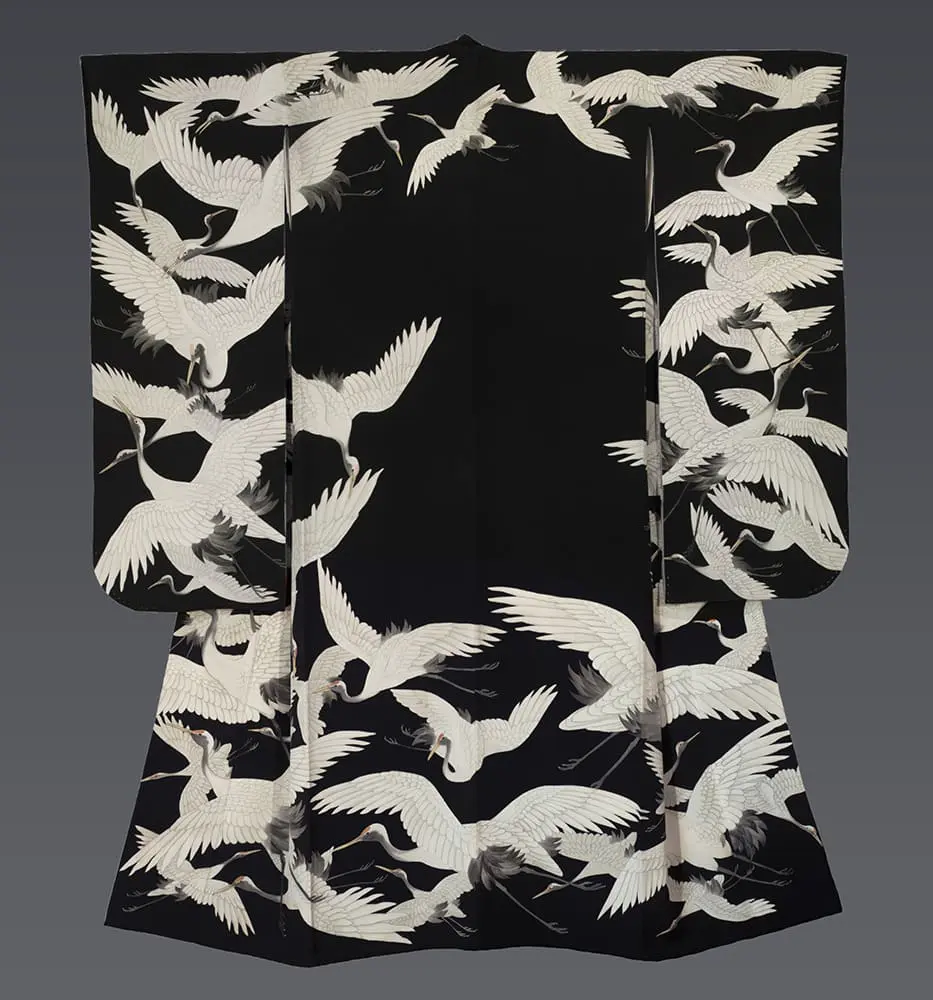


This wedding kurofurisode treats the textile not as a grid, but as a singular, flowing canvas. This piece represents the Nihonga (Japanese-style painting) influence on fashion, where the garment is conceived as a 360-degree painting that wraps the body.
The motif features a dynamic, swirling flock of Japanese Red-crowned Cranes (tancho), a symbol of fidelity and longevity (said to live for 1,000 years). Unlike the heavy, stiff embroidery often found on bridal wear, these birds are rendered using Yuzen (hand-painted resist dyeing) in a style that mimics Sumi-e (ink wash painting). The artist has used gradations of grey and white to create the softness of feathers, relying on the contrast with the deep black silk to provide drama.
The composition is asymmetrical and kinetic; the birds are not static symbols but are captured in mid-flight, tumbling from the shoulder to the hem. This "all-over" placement differs from the bottom-heavy patterns of the Edo period, reflecting the periods desire for movement and dynamism. By stripping away the usual polychrome flowers and gold leaf, the artist created a minimalist, monochromatic masterpiece that relies entirely on the quality of the brushwork. It is a garment that asserts that the wearer is not just a bride, but a work of art.
It measures 50 inches (127 cm) from sleeve-end to sleeve-end and stands at 60 inches (152 cm) in height. Typically, formal furisode bears five family crests called "mon," yet this particular one, for unknown reasons, lacks any of these crests.
This artwork is featured on pages 336-337 of Ceremonial Textiles of Japan, 18th to 20th Centuries. This book, published by Yorke Antique Textiles, can be previewed or purchased on our website here.
This piece also featured on page 97 of the Spring 2022 edition of Arts of Asia.
Display & Installation Notes
Historical Context


Payment Options: We primarily accept PayPal for all transactions. Credit and debit cards are not accepted. If you prefer to pay by personal check instead of PayPal, please note this preference in the "Additional comments" field when placing your order.Ordering Process
To receive your PayPal invoice, simply fill out the form.
Shipping Details: We ship all orders to the address associated with your PayPal payment. Please ensure your PayPal shipping address is current and accurate.A phone number is required during checkout, as our shipping carrier may need to contact you regarding delivery questions.Shipping RatesUnited States and Canada: $20International destinations (air mail): $40