.avif)

Royal Blue Furisode: Neon Iris & Gold Yukiwa Art
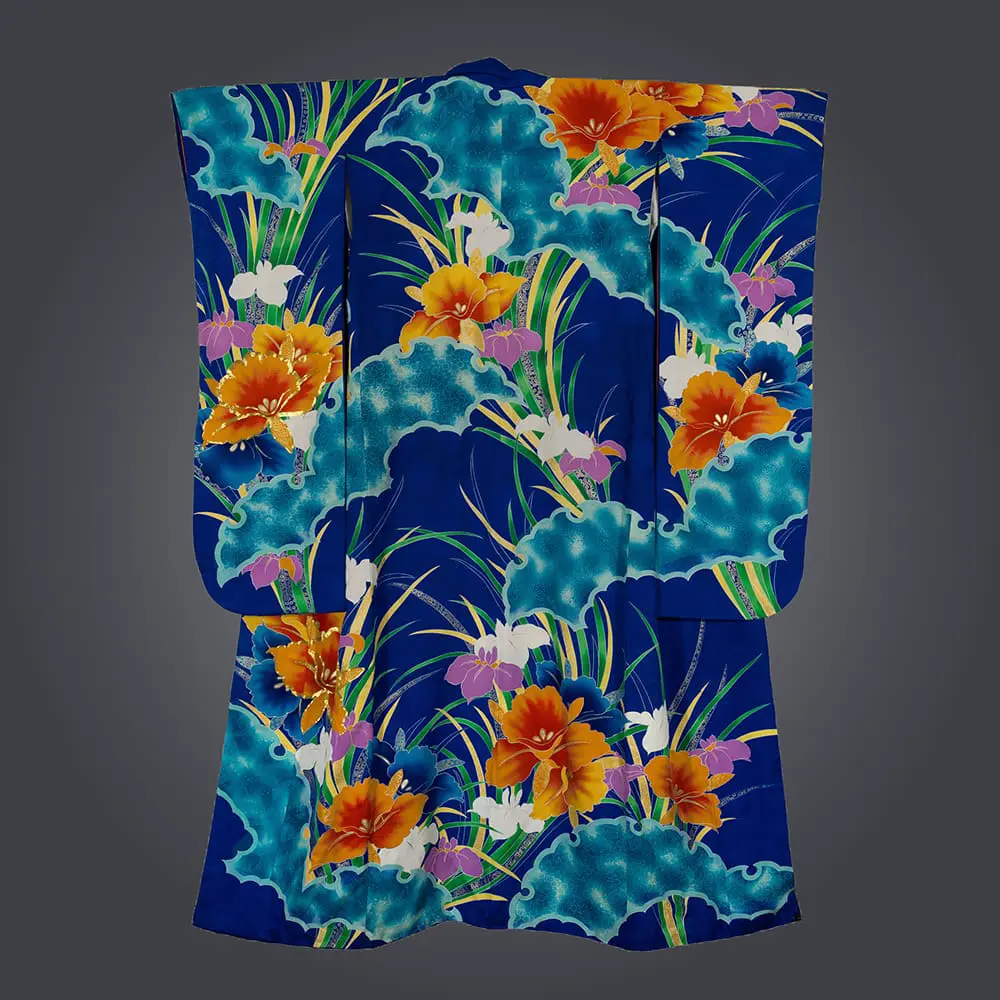


This 1990s furisode is a quintessential example of Heisei-era exuberance, representing a "maximalist" approach to textile design that characterized the fashion of the Japanese economic bubble and its immediate aftermath. The garment is a technical tour-de-force, layering multiple sophisticated methods—resist-dyeing, embroidery, embossing, and hand-painting—to create a surface that is as tactile as it is visually arresting. The deep, electric royal blue ground serves as a dramatic stage for the high-contrast palette of neon orange, bright yellow, and turquoise. This hyper-saturated coloration marks a distinct departure from the earthy tones of the 1970s or the muted chic of the Edo period, embracing instead a synthetic, "technicolor" vibrancy made possible by modern chemical dyes.
The central motifs are stylized interpretations of irises (kakitsubata or ayame) and perhaps lilies, rendered with a dynamism that borders on fantasy. The flowers are not depicted in a quiet, naturalistic state but are exploding with color and movement, outlined in gold leaf (kindaishi) to catch the light. Interwoven with the floral elements are large, scalloped forms filled with a stippled texture. These turquoise shapes appear to be a modern, printed simulation of kanoko shibori (fawn-spot tie-dye), used here to create "snow ring" (yukiwa) or cloud-like boundaries. The interplay between the crisp, hand-painted flowers (yuzen) and the textured, volume-rich shibori areas creates a complex depth of field, making the flat fabric appear three-dimensional.
Artistically, this kimono reflects a specific 1990s trend known as the "Tsujigahana Revival." Tsujigahana was a "lost" technique of the 16th century that combined tie-dye with hand-painting. In the late 20th century, spurred by the works of textile artists like Kubota Itchiku, this style saw a massive commercial resurgence. This furisode borrows that aesthetic—specifically the mixing of hazy, tie-dyed backgrounds with sharp, painted foregrounds—but updates it with a Pop-Art color sensibility. The combination of summer flowers (irises) with winter motifs (snow rings) also signals a Post-Modern approach to seasonality, where traditional rules are bent to prioritize purely decorative impact and an overwhelming sense of celebration suitable for a young woman’s Coming of Age ceremony.
Spanning about 51 inches (130 cm) from sleeve-end to sleeve-end, this furisode stands tall at approximately 69 inches (175 cm).
Display & Installation Notes


Payment Options: We primarily accept PayPal for all transactions. Credit and debit cards are not accepted. If you prefer to pay by personal check instead of PayPal, please note this preference in the "Additional comments" field when placing your order.Ordering Process
To receive your PayPal invoice, simply fill out the form.
Shipping Details: We ship all orders to the address associated with your PayPal payment. Please ensure your PayPal shipping address is current and accurate.A phone number is required during checkout, as our shipping carrier may need to contact you regarding delivery questions.Shipping RatesUnited States and Canada: $20International destinations (air mail): $40