.avif)

Summer Kimono: Blue & Magenta Futurist Ikat
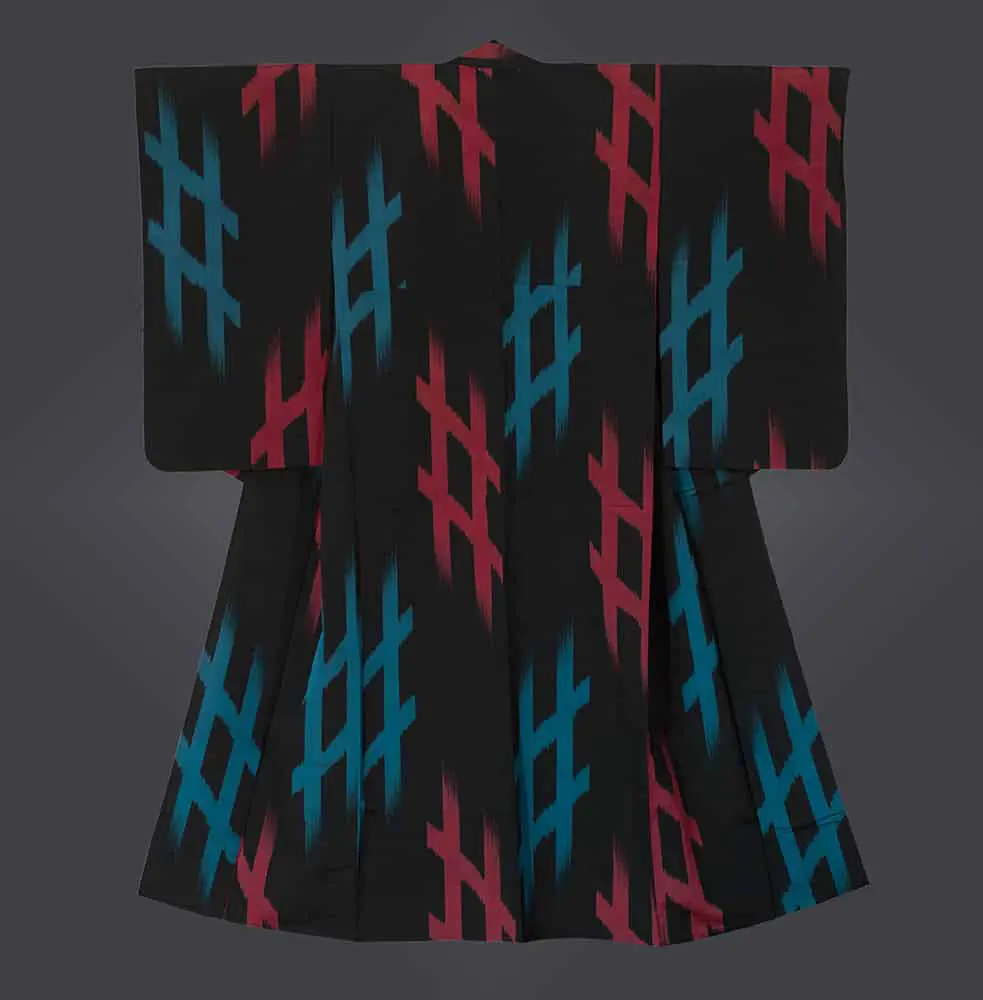


This 1930s summer silk kimono is a striking demonstration of tate-gasuri (warp ikat), an ancient dyeing method recontextualized here to achieve a distinctly modern, avant-garde aesthetic. The technique involves resist-dyeing the vertical warp threads prior to placing them on the loom. Because the pattern is dyed only onto the vertical threads, the resulting design features characteristic "streaked" or blurred edges at the top and bottom of each motif, while the side edges remains relatively crisp. This creates a visual effect of vertical motion, as if the shapes are raining down or vibrating with speed, a quality that gives the garment a kinetic energy impossible to achieve with flat stencil printing.
The visual composition relies on a stark, high-contrast palette typical of the Showa era's fascination with synthetic dyes. Against a void of deep, midnight black, large, floating geometric forms in electric blue and magenta red command attention. The motif appears to be a highly stylized, slanted variation of the igeta (well curb). While the well curb is a traditional symbol of life-giving water and family continuity, its presentation here is radically abstracted. By tilting the axis and isolating the shape, the artist has stripped away the motif's rustic associations, transforming it into a pure study of line and intersection that resembles the "hash" symbol (#) familiar to modern eyes.
Artistically, this textile aligns with the principles of Constructivism and Futurism, movements that glorified speed, technology, and geometric purity. The slanted, falling arrangement of the motifs suggests dynamism and the fast pace of modern urban life, a sharp departure from the static, contemplative nature scenes of the Meiji period. This design would have been worn by a woman who wished to project an image of "coolness"—both in the physical sense, aided by the watery symbolism of the well curb and the open weave of the silk, and in the metaphorical sense of being fashionable, sharp, and attuned to the global trends of the 1930s.
Its dimensions are approximately 46 inches (117 cm) by 57 inches (145 cm).
This artwork is featured on page 241 of Art Kimono: Aesthetic Revelations of Japan, 1905-1960. This book, published by Yorke Antique Textiles, can be previewed or purchased on our website here.
Display & Installation Notes
Historical Context


Payment Options: We primarily accept PayPal for all transactions. Credit and debit cards are not accepted. If you prefer to pay by personal check instead of PayPal, please note this preference in the "Additional comments" field when placing your order.Ordering Process
To receive your PayPal invoice, simply fill out the form.
Shipping Details: We ship all orders to the address associated with your PayPal payment. Please ensure your PayPal shipping address is current and accurate.A phone number is required during checkout, as our shipping carrier may need to contact you regarding delivery questions.Shipping RatesUnited States and Canada: $20International destinations (air mail): $40