.avif)

Meisen Kimono: Electric Blue Dragonfly Pop Art
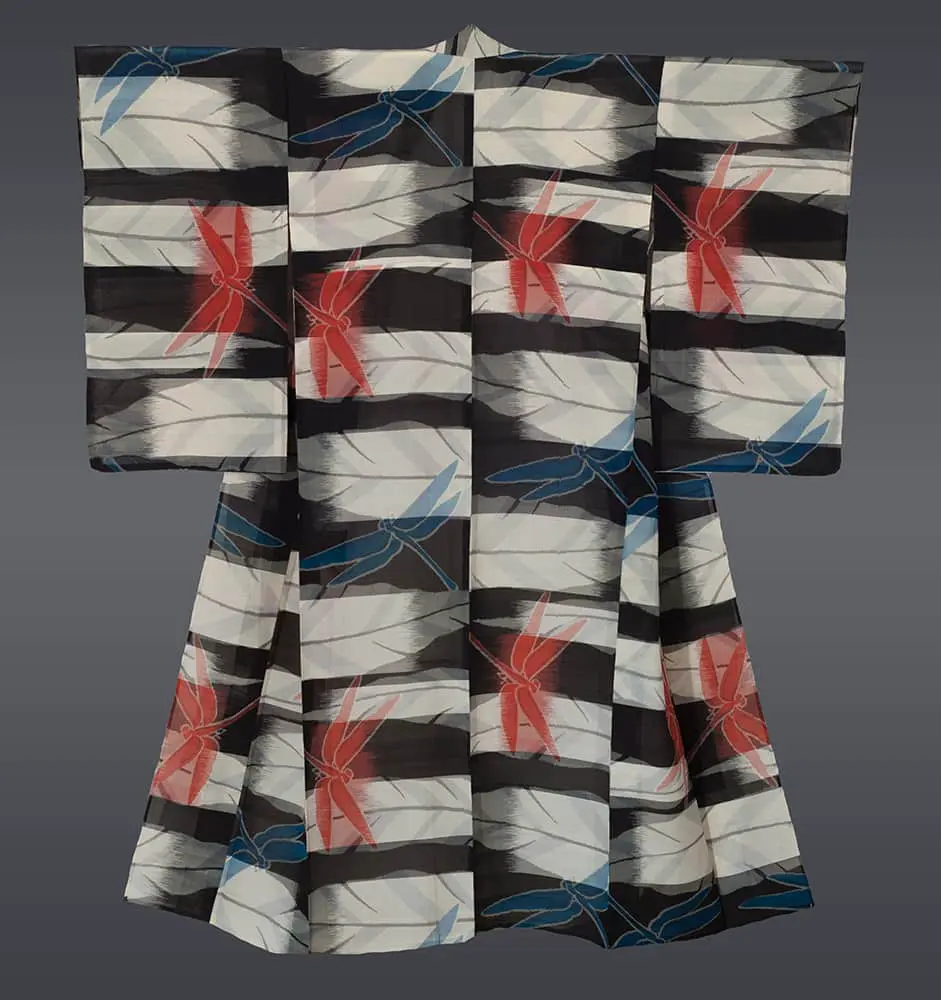


This kimono highlights the rise of rayon (known as jinken or "artificial silk") as a fashionable alternative to natural fiber. The fabric possesses a high-gloss, synthetic sheen and a slightly heavier drape than silk, which serves to amplify the saturation of the chemical dyes, resulting in colors that are punchy, opaque, and undeniably modern.
The visual composition is a striking example of post-war graphic design, utilizing the hogushi-giori (stencil-dyed warp) technique to create the signature blurred edges of the Meisen style. The background is organized into bold, horizontal blocks of black and white, creating a "venetian blind" effect that provides a rigid, geometric structure. Floating within the white bands are large, ghost-like grey feathers, which add a layer of softness and texture. Superimposed over this monochromatic grid are massive dragonflies in alternating electric blue and tomato red. The "fuzzy" quality of the Meisen weave is particularly effective here; it gives the dragonflies a vibrating appearance, as if their wings are buzzing in mid-flight, enhancing the sense of kinetic energy.
Symbolically, this garment doubles down on the imagery of flight and air. The dragonfly (tombo) is the "victory insect" that flies only forward, a symbol of resilience and positive momentum that would have resonated in the post-war reconstruction era. By pairing the dragonfly with feathers (hane), the design emphasizes weightlessness, aerodynamics, and the cooling breeze of summer. Artistically, the sheer scale of the motifs—which dominate the wearer’s body rather than decorating it—aligns with the bold, poster-like sensibilities of Mid-Century Modern and early Pop Art. This is a garment designed to be seen from a distance, prioritizing visual impact and "modern" synthetic brightness over traditional subtlety.
It measures 49 inches (124 cm) from sleeve-end to sleeve-end and stands at a height of 57 inches (145 cm).
Display & Installation Notes


Payment Options: We primarily accept PayPal for all transactions. Credit and debit cards are not accepted. If you prefer to pay by personal check instead of PayPal, please note this preference in the "Additional comments" field when placing your order.Ordering Process
To receive your PayPal invoice, simply fill out the form.
Shipping Details: We ship all orders to the address associated with your PayPal payment. Please ensure your PayPal shipping address is current and accurate.A phone number is required during checkout, as our shipping carrier may need to contact you regarding delivery questions.Shipping RatesUnited States and Canada: $20International destinations (air mail): $40