.avif)

Taisho Bamboo Kimono: Maroon & Violet Art Nouveau Art
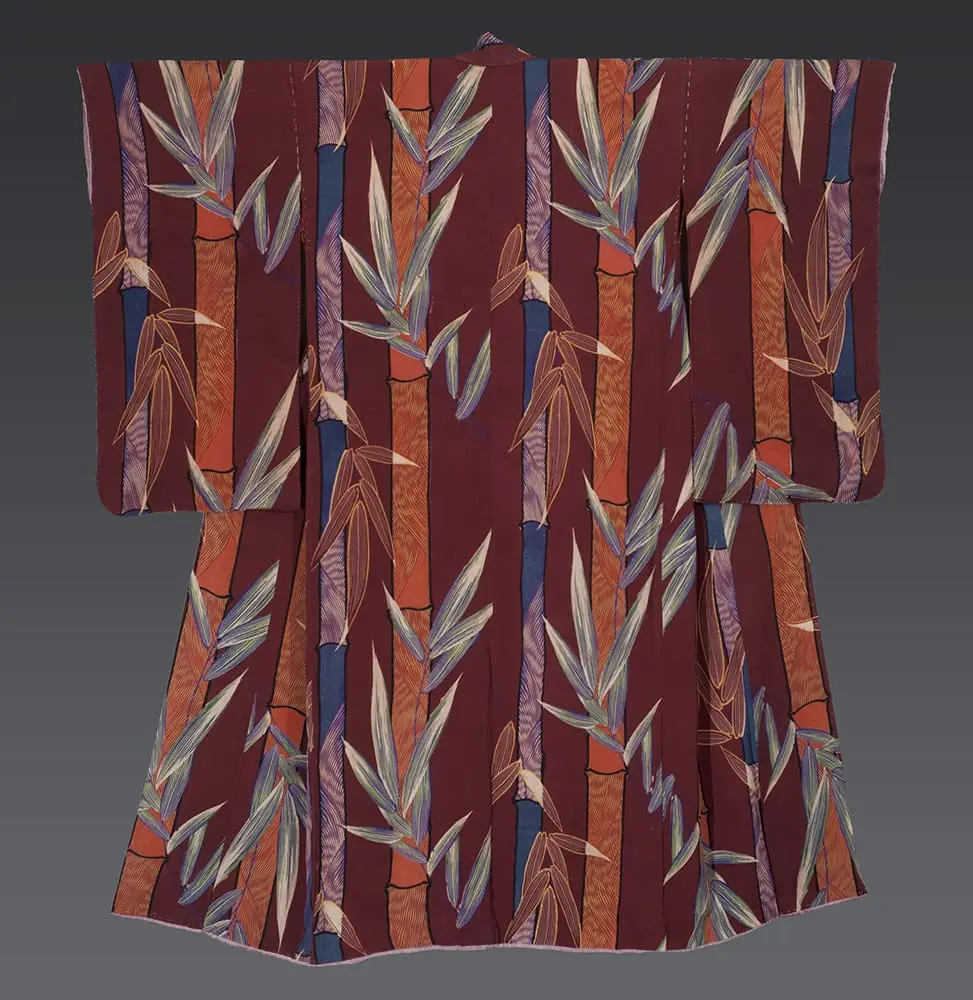


This kimono features a rich, deep maroon background—a color often favored in this era for its warmth and maturity—overlaid with a striking, forest-like arrangement of bamboo stalks. The design is executed through katazome (stencil dyeing), but the application is particularly refined; the close-up reveals that the artist used the stencil to create fine, parallel hatching lines within the bamboo stalks and leaves. This technique mimics the texture of woodgrain or the brushstrokes of a sketch, adding a layer of tactile visual interest to the flat fabric.
The composition is dominated by the verticality of the bamboo, which creates a striped effect that elongates the wearer’s silhouette. However, this rigidity is playfully disrupted by the chaotic, diagonal intersection of the sharp leaves. The color palette is distinctly modern for its time, pairing the traditional rust-orange of the bamboo with an unexpected, synthetic violet-blue. This juxtaposition of warm earth tones with cool, electric hues is a hallmark of the 1920s, reflecting a departure from the strict color rules of the Edo period in favor of individual expression and bold graphic impact.
Symbolically, bamboo (take) represents resilience, flexibility, and upright integrity, as the plant bends in the wind but never breaks. In the context of the Taisho era—a time of rapid democratization, feminism, and social change—this symbolism takes on a modern resonance, suggesting a wearer who possesses the strength to adapt to a changing world without losing their core identity. Artistically, the design bridges the gap between the organic curves of Art Nouveau (seen in the natural subject matter) and the geometric abstraction of Art Deco (seen in the reduction of the bamboo to tubular, striped forms)
The art piece measures 48 inches (121.9 cm) in width and 54 inches (137.2 cm) in height.
Display & Installation Notes


Payment Options: We primarily accept PayPal for all transactions. Credit and debit cards are not accepted. If you prefer to pay by personal check instead of PayPal, please note this preference in the "Additional comments" field when placing your order.Ordering Process
To receive your PayPal invoice, simply fill out the form.
Shipping Details: We ship all orders to the address associated with your PayPal payment. Please ensure your PayPal shipping address is current and accurate.A phone number is required during checkout, as our shipping carrier may need to contact you regarding delivery questions.Shipping RatesUnited States and Canada: $20International destinations (air mail): $40