.avif)

Pink Chirimen Kimono: Minka Farmhouse Landscape Art
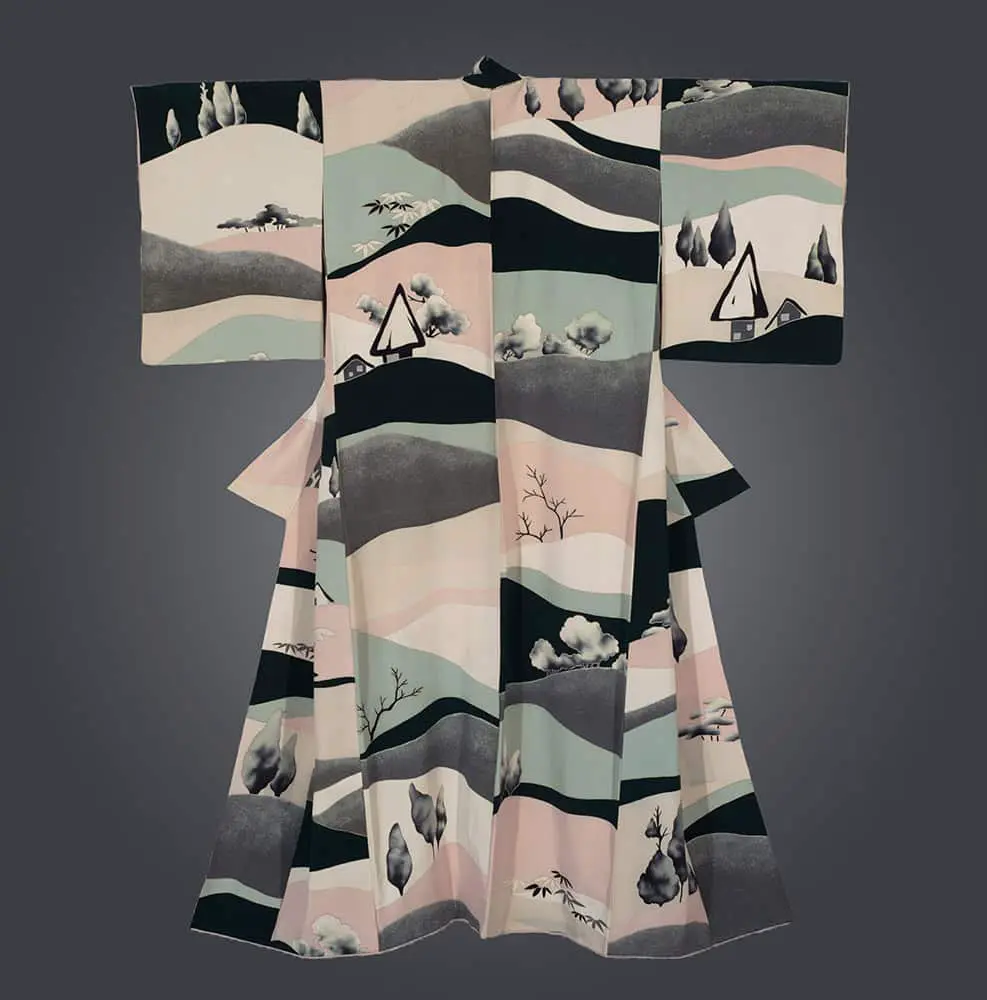


This kimono is a beautiful example of the Furusato (hometown) aesthetic, rendered on textured chirimen (silk crepe) fabric. The chirimen weaves creates a bumpy, light-diffusing surface that gives the hand-painted dyes a soft, matte finish, enhancing the dreamy, atmospheric quality of the scene. The design features a stylized, rolling landscape composed of soft waves of color—blush pink, celadon green, and slate grey—which act as abstracted hills or mist. Nestled within these hills are distinct, geometric motifs of thatched-roof farmhouses (minka) and stylized trees. The painting style is deliberately naïve and graphic, resembling a woodblock print or a paper cutout (kirie), with bold black outlines that contrast sharply against the pastel "sugar-pop" background.
This textile is a direct product of the "Furusato Boom" (Hometown Boom) of the 1970s. As Japan underwent rapid industrialization and urbanization during its "economic miracle," there was a massive cultural counter-movement fueled by nostalgia for the vanishing rural way of life. This kimono rejects the sharp, machine-age Modernism of the previous decades (like the Op-Art kimono) in favor of a Neo-Folk or Mingei (Folk Craft) revival style. It also touches on the "Melchen" (from the German Märchen for fairy tale) trend popular in 70s shōjo (girls') manga and illustration, where traditional subjects were reimagined with a cute, storybook-like whimsy and a pastel palette.
The central motif is the thatched-roof farmhouse (kayabuki yane). By the 1970s, these houses were disappearing rapidly from the Japanese countryside; placing them on a kimono turned them into a symbol of an idealized, lost innocence and the warmth of a "spiritual home" that many urban Japanese were yearning for. The stylized cedar trees and rolling mountains further emphasize this rural idyll. Unlike the classical "scholar's landscape" (sansui) which depicts majestic, terrifying nature, this is a domesticated, "cozy" landscape, designed to evoke feelings of comfort and sentimental longing for a simpler past.
There's a light, sizable stain on the inner upper lining (doura) and some inconspicuous foxing on the outer. The kimono measures 49 inches from sleeve-end to sleeve-end and 59 inches in height (124 cm x 150 cm).
Display & Installation Notes


Payment Options: We primarily accept PayPal for all transactions. Credit and debit cards are not accepted. If you prefer to pay by personal check instead of PayPal, please note this preference in the "Additional comments" field when placing your order.Ordering Process
To receive your PayPal invoice, simply fill out the form.
Shipping Details: We ship all orders to the address associated with your PayPal payment. Please ensure your PayPal shipping address is current and accurate.A phone number is required during checkout, as our shipping carrier may need to contact you regarding delivery questions.Shipping RatesUnited States and Canada: $20International destinations (air mail): $40