.avif)

Art Deco Meisen Silk Kimono with Peony
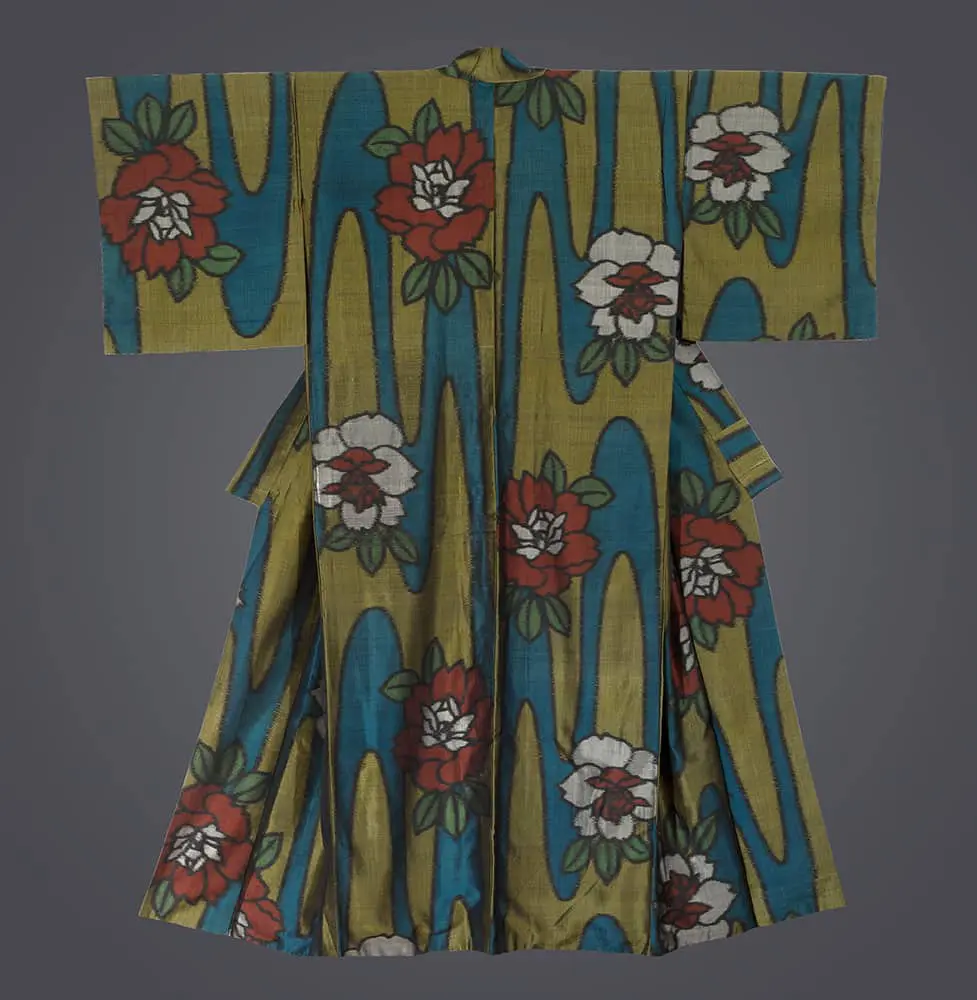


This bold 1930s meisen silk kimono presents a striking composition of lush peony blossoms scattered across a dramatically abstracted ground of interlocking vertical forms in olive-gold and cerulean blue. The background pattern features elongated, irregular shapes with rounded tops and pointed bases that interlock like fingers or dripping stalactites, creating a powerful sense of vertical movement and depth. This abstract ground is achieved through the meisen technique — a form of kasuri (ikat) weaving in which the warp and weft threads are pre-dyed with stenciled patterns before being woven together. The characteristic slight blurring where colors meet, visible in the soft edges between the gold and blue fields, is the signature hallmark of meisen, giving the fabric a shimmering, almost vibrating quality that no other dyeing method can replicate.
The peonies themselves are rendered in a deliberately flattened, graphic style, alternating between rich vermilion red and creamy white, each crowned with dark green foliage. Their bold outlines and simplified forms recall the aesthetic of Art Nouveau's stylized botanical motifs, yet their flat, poster-like treatment also anticipates the screen-printed sensibility of Pop Art. The deliberate contrast between the organic roundness of the flowers and the sharp, angular abstraction of the background creates a dynamic visual tension that feels remarkably modern.
The peony, or "botan," holds a place of deep significance in Japanese culture. Known as the "king of flowers," it symbolizes wealth, honor, nobility, and good fortune. In the language of Japanese art, it also represents boldness and feminine beauty — qualities perfectly embodied in this garment's unapologetic scale and saturated color. The background pattern evokes a highly abstracted interpretation of "tatewaku," the traditional rising steam motif, though here it has been transformed into something far more dramatic and contemporary.
The overall effect is one of extraordinary confidence — the oversized florals, the audacious color pairing of gold against teal, and the tension between naturalistic subject and abstract ground speak to the creative fearlessness of early Shōwa-period textile artists.
It measures approximately 50 inches (127 cm) by 57 inches (145 cm).
This artwork is featured on page 219 of Art Kimono: Aesthetic Revelations of Japan, 1905-1960. This book, published by Yorke Antique Textiles, can be previewed or purchased on our website here.
Display & Installation Notes


Payment Options: We primarily accept PayPal for all transactions. Credit and debit cards are not accepted. If you prefer to pay by personal check instead of PayPal, please note this preference in the "Additional comments" field when placing your order.Ordering Process
To receive your PayPal invoice, simply fill out the form.
Shipping Details: We ship all orders to the address associated with your PayPal payment. Please ensure your PayPal shipping address is current and accurate.A phone number is required during checkout, as our shipping carrier may need to contact you regarding delivery questions.Shipping RatesUnited States and Canada: $20International destinations (air mail): $40