.avif)

Taisho Roman Kimono: Pink & Charcoal Art Nouveau Vine
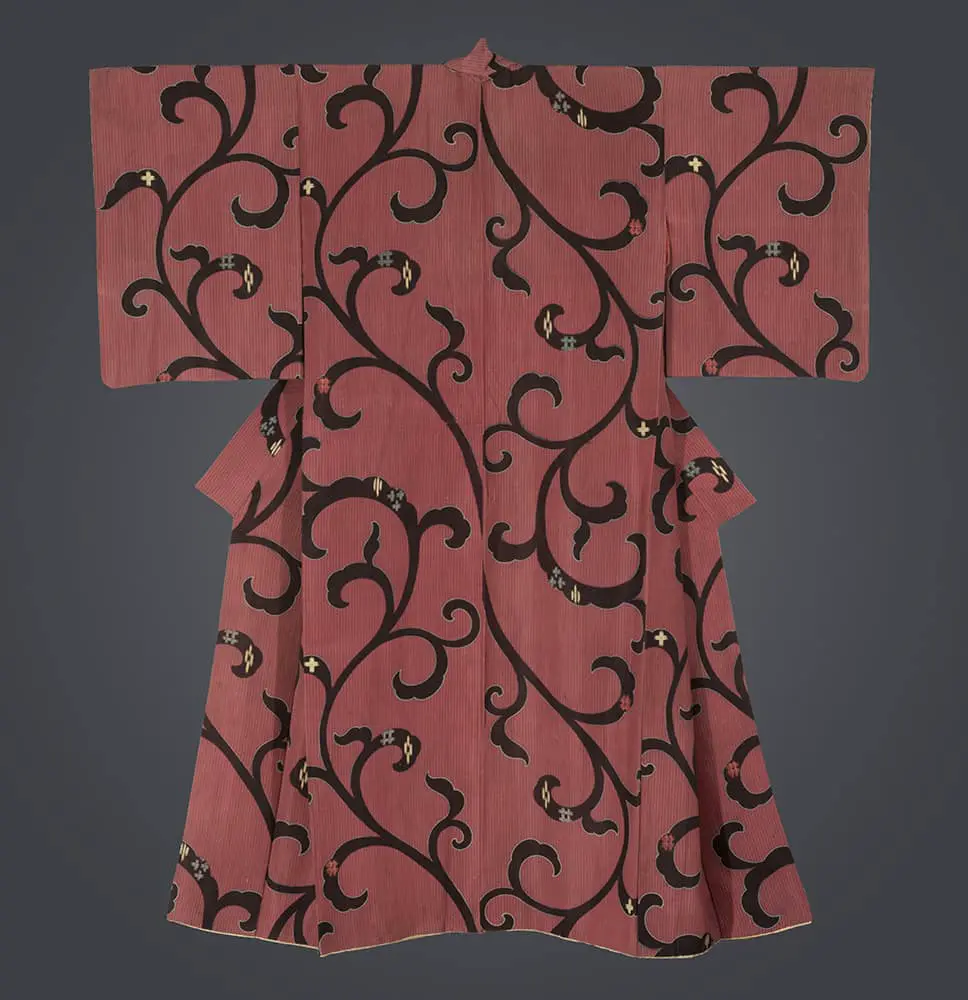


This kimono illustrates the era's penchant for enlarging traditional motifs to create bold, emotional statements. The garment features a dusty, muted rose background—a color often referred to as "old rose" or ebicha—which was highly fashionable during this period for its romantic, nostalgic quality. Against this soft, feminine ground, the artist has applied a monumental, high-contrast design using katazome (stencil dyeing). The crispness of the stencil work allows the dark, charcoal-colored vines to stand out with graphic clarity, while small, multicolored geometric accents in yellow, white, and teal are nestled within the curves, adding a playful "pattern-on-pattern" complexity.
The dominant motif is a radical modernization of the karakusa (scrolling arabesque or "Chinese grass"). Traditionally, karakusa was used as a background filler pattern, symbolizing eternal prosperity and the uninterrupted continuity of a family lineage, as the vines grow and loop indefinitely without end. However, in this design, the motif is no longer a background element but the main event. The vines have been magnified to a colossal scale, sweeping across the body in giant, sinuous loops. The terminals of the vines curl inward like fern fiddleheads, and the inclusion of the small geometric splashes inside these curls mimics the look of kasuri (ikat) weaving, a clever visual trick where a printed design simulates the prestige of a woven one.
Artistically, this textile demonstrates the seamless hybridization of Japanese tradition and Western Art Nouveau. While the subject matter is the classic Japanese vine, the execution is pure Art Nouveau; the curves possess the signature "whiplash" energy and organic fluidity that defined the European movement. This specific style of karakusa—bold, thick, and dominating the visual field—reflects the confident spirit of the Taisho woman. It retains the auspicious wish for longevity but expresses it with a dramatic flair that prioritizes modern fashion and individual expression over conservative modesty.
It measures approximately 49 inches (124 cm) along the shoulders and stands at about 55 inches (140 cm) in height.
Display & Installation Notes


Payment Options: We primarily accept PayPal for all transactions. Credit and debit cards are not accepted. If you prefer to pay by personal check instead of PayPal, please note this preference in the "Additional comments" field when placing your order.Ordering Process
To receive your PayPal invoice, simply fill out the form.
Shipping Details: We ship all orders to the address associated with your PayPal payment. Please ensure your PayPal shipping address is current and accurate.A phone number is required during checkout, as our shipping carrier may need to contact you regarding delivery questions.Shipping RatesUnited States and Canada: $20International destinations (air mail): $40