.avif)

Silkscreened Kimono with Ume Blossoms on Magenta Ground
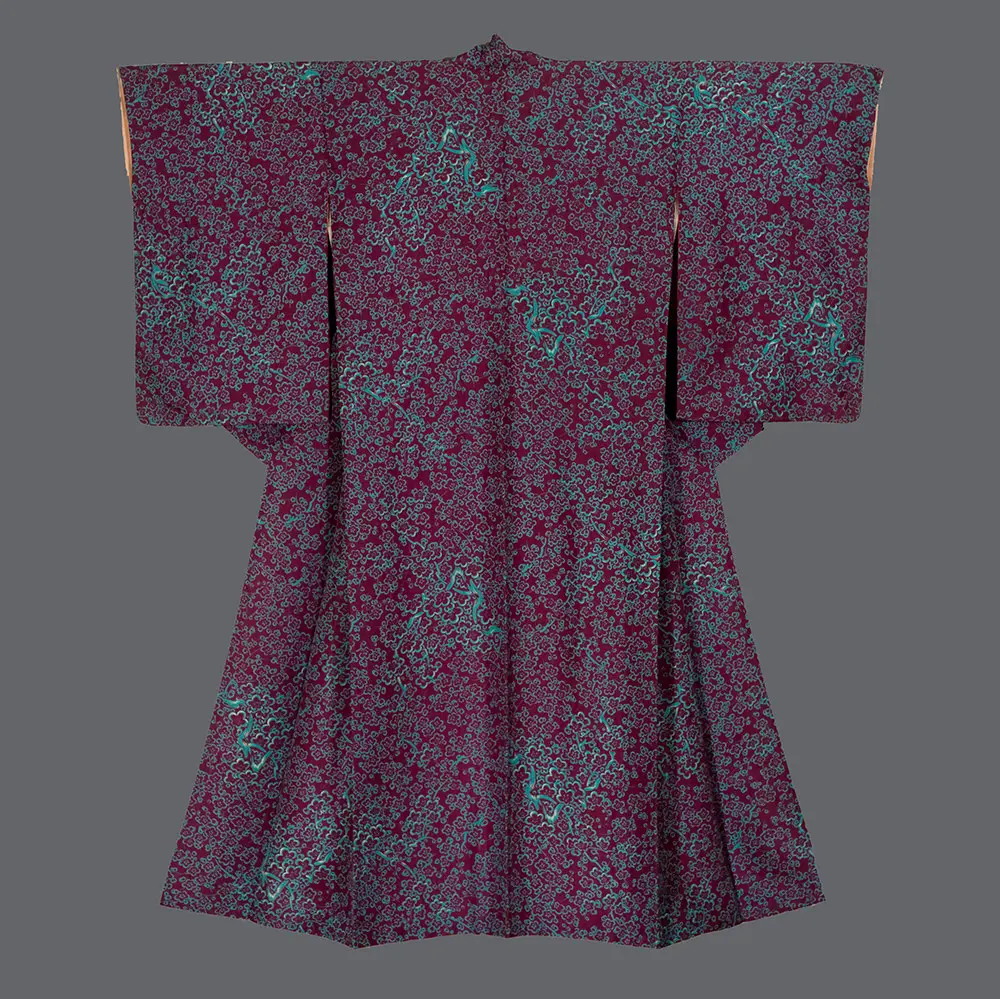


This silk kimono showcases an allover pattern of ume (plum blossoms) rendered through silkscreen printing, a technique that gained prominence during this era for its ability to produce intricate, repeating designs efficiently. The deep magenta-burgundy ground provides a rich, saturated backdrop against which countless small plum blossoms appear outlined in pale lavender-blue, while turquoise branches wind sinuously throughout the composition, creating organic movement across the fabric's surface.
Plum blossoms hold profound significance in Japanese culture as the first flowers to bloom in late winter, often appearing while snow still covers the ground. They symbolize perseverance, renewal, hope, and the triumph of beauty over adversity. In the traditional hierarchy of beloved flowers, plum ranks alongside cherry and chrysanthemum as one of the most celebrated botanical motifs.
The dense, tapestry-like quality of this pattern—with blossoms and branches interlocking across every surface—creates visual richness that rewards close examination while reading as unified texture from a distance. This approach differs from designs that feature isolated motifs against empty ground, instead embracing horror vacui with delicate botanical forms. The unexpected color combination of magenta with turquoise and lavender demonstrates the adventurous chromatic experimentation characteristic of this period, when Western color theories and Art Nouveau influences merged with Japanese aesthetic traditions. The warm peach-toned lining visible at sleeve openings provides complementary contrast to the cool-toned surface pattern.
It measures 49 inches (124 cm) from sleeve-end to sleeve-end and stands at a height of 58 inches (147 cm).
Display & Installation Notes


Payment Options: We primarily accept PayPal for all transactions. Credit and debit cards are not accepted. If you prefer to pay by personal check instead of PayPal, please note this preference in the "Additional comments" field when placing your order.Ordering Process
To receive your PayPal invoice, simply fill out the form.
Shipping Details: We ship all orders to the address associated with your PayPal payment. Please ensure your PayPal shipping address is current and accurate.A phone number is required during checkout, as our shipping carrier may need to contact you regarding delivery questions.Shipping RatesUnited States and Canada: $20International destinations (air mail): $40